If water is pouring over the front of your gutter in heavy rain, the first question is whether it’s a blockage or a fault. People searching for gutter repair in Bath often have a gutter that’s simply full. Others have a gutter that’s genuinely failing and won’t be fixed by clearing it.
The two look similar from the pavement, but they have different fixes and different costs. On the Victorian terraces around Oldfield Park, we see both, often on the same street. Here’s how to tell them apart before the winter rain arrives.
Why Oldfield Park Terraces Get Gutter Trouble
A long run of terraced houses means long, shared-looking roof edges, often with a few downpipes serving a lot of roof. Add the mature street trees and gardens nearby and you get a lot of leaf fall landing on slate or tile and washing straight into the gutters. Most of it ends up at the outlets, where it clogs.
That’s the typical pattern: gutters that coped fine in summer start overflowing in October or November, usually at the same spots each year. Once that happens, the problem tends to show up in one of three ways: overflow, sagging, or damp patches.
Signs It’s a Blockage
A blockage is the more common cause, and the good news is it’s the cheaper one to sort. Look for:
- Water spilling over the front lip in heavy rain, especially above a downpipe or at the low end of a run
- Plants or moss growing in the gutter, which you can sometimes see from an upstairs window or the opposite pavement
- Tide marks or green streaking on the wall or fascia below the gutter
- Water running down the wall rather than dripping cleanly from the outlet
- Overflow that stops soon after the rain does, rather than constant dripping in dry weather
If your gutter only misbehaves in downpours and looks tidy and level when the weather’s dry, a blockage is the most likely culprit. Our guide on how to tell if your gutters need cleaning goes through the signs in more detail, and autumn leaves blocking downpipes covers the outlet end of the problem.
Signs It’s a Fault
A fault is something the gutter itself has done: it’s cracked, loose, tilted or leaking. Signs include:
- Dripping from a joint or from the underside of the run, including in light rain with no overflow at the front
- A visible sag between brackets, or a gutter that’s pulled away from the fascia
- A fall that’s gone wrong, with water pooling in one section when it should be running to the outlet
- Cracks, splits or rust on the gutter, or a missing or broken bracket
- Damp patches that stay put on the wall or inside the house even after the rain stops, particularly below a joint or a corner
A sagging run can be either. A gutter full of wet leaves and sludge is heavy, and that weight can pull a run down. But if the brackets have failed or the fascia behind has gone soft, the gutter will sag whether it’s clean or not.
The simplest way to find out is to clear it and look again.
What Clearing From the Ground Fixes
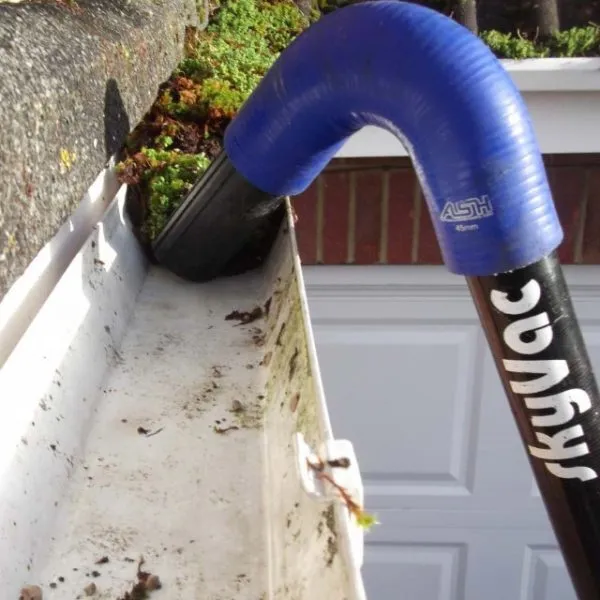
We clear gutters with the SkyVac, a ground-based vacuum system, and finish by hand where needed. It means no ladders against your gutters and no leaning on old brackets. That’s useful on older terraces, where it’s better not to put extra load on the gutter or the fascia.
Clearing will sort:
- Overflow caused by leaves, moss, silt and general debris
- Blocked outlets and the top of downpipes
- Plants and seedlings taking root in the run
- Nesting material and debris pushed in by birds. This is common if you have solar panels, and we cover that in birds under solar panels and the winter gutter problem
It also shows you what you’re dealing with. Once the debris is out, a gutter that was overflowing and now runs freely was a blockage. A gutter that still drips at a joint or holds water was telling you something else.
To be realistic, clearing doesn’t repair anything. It won’t re-seal a joint, re-fix a bracket or straighten a run that has dropped. If your gutter was already cracked or loose, a clear will give you a clear view of that, but it won’t make it go away.
What Needs a Gutter Fitter
Call a gutter fitter when the clear shows:
- Joints that leak even when the gutter is empty
- Brackets that are loose, missing or rusted through
- Sections that sag or pool after clearing
- Cracked or split lengths
- Rotten fascia boards behind the gutter, which need sorting before anything is re-fixed
- Downpipes that are broken or disconnected
Some of these are small jobs, like re-sealing a joint or replacing a bracket. Others, like a full run that has lost its fall, can mean replacing sections. We can’t give a useful price without seeing it, and neither can anyone else. Costs depend on the height of the house, the material, how much needs replacing and the access. Get a quote from a fitter who has actually looked at your gutter.
Why It’s Worth Clearing First
If you’re not sure which problem you have, clearing first usually saves money. A fitter looking at a gutter full of debris can’t see joints, brackets or the true fall of the run. A clear gutter lets them quote for what’s actually wrong, and you may find the answer is “nothing, it was just full.”
Ignoring it isn’t a great plan either. Overflowing water soaks fascias and runs down the wall, which can lead to damp patches, staining and rot in the timber behind. That’s a bigger bill than a gutter clear.
When to Do It: November and December
The most useful clear of the year is after the leaves have mostly come down, which in the Bath area usually means November into December. Clear too early and you can be back to full gutters within a few weeks as the last of the leaves fall.
A clear at that point leaves your gutters and downpipes ready for the heaviest rain of winter. If you do spot a fault during that clear, you’ll have time to get a fitter in before the worst of the weather rather than discovering the problem in a January downpour.
A Simple Check You Can Do Yourself
Next time it rains hard, stand outside (with an umbrella) and watch for about five minutes. Note where water leaves the gutter and where it falls:
- Over the front, above a downpipe: probably a blockage
- Dripping from a joint or corner: probably a fault
- Running down the wall in a long streak: could be either, so clear it and check again
- Dripping steadily from a section that looks sagged: likely a fault, possibly with a blockage making it worse
Take a photo of any problem spots; it helps whoever comes to look.
If your terrace gutters are overflowing or you can’t tell what’s going on up there, take a look at our gutter cleaning in Oldfield Park page. We’re happy to give you a free quote and tell you honestly whether it looks like a clear or a job for a gutter fitter. You can get in touch here or call Monday to Friday 8am to 5pm, or Saturday 9am to 3pm.