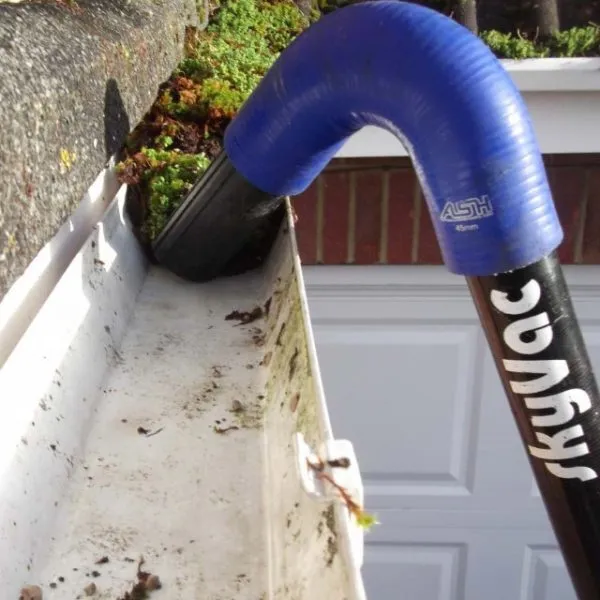
Every autumn the same phone call comes in: “my gutter’s overflowing and it hasn’t even rained that hard.” The owner usually thinks the gutter itself has a problem. Nine times out of ten the gutter is fine — the downpipe is blocked, and autumn leaves are why.
The Blockage Isn’t Where You Think
Here’s the part most people miss: leaves don’t stay in the gutter.
When rain falls on a gutter full of leaves, the water washes them along the channel towards the outlet. Everything at the outlet — leaf fragments, moss silt, twigs, the odd tennis ball — has to fit through the downpipe opening. The debris that makes it into the downpipe compacts with every flush. Eventually the pipe blocks solid, and from that moment the gutter itself can’t drain, no matter how clean the channel looks from the ground.
That’s why an overflowing gutter and an apparently empty one can both point to the same fault. A quick look tells you which: if water spills over the edge but the channel above it is visibly clear, the blockage is below — in the downpipe or the hopper head.
Why Winter Is When the Damage Happens
A blocked gutter in July is an inconvenience. A blocked gutter in December is a repair bill.
- Overflow runs during every rain event. Winter rain is frequent and long rather than heavy — the water keeps hitting the same stretch of wall for days at a time.
- Walls stay wet. Low sun, cold brickwork and short days mean a saturated wall never properly dries out. Penetrating damp shows up inside, usually in the room directly under the gutter line.
- Frost gets into everything. Water trapped in saturated fascia boards, brick joints and gutter seals expands when it freezes, opening cracks that let more water in. Freeze-thaw damage compounds through the winter.
- The weight can pull fixings. A gutter holding standing water plus compacted debris is heavier than people expect — the classic sagging section that needs realignment in spring often started as an autumn blockage.
Clearing the blockage in November prevents all of it. Clearing it in February means the wall has already spent four months taking the overflow.
The Leaves That Cause It in Bath and Bristol
The street trees here are unusually good at it:
- Sycamore leaves clump together wet and form a mat that seals the outlet
- Lime trees add sticky honeydew that binds debris into a plug
- Plane trees (all over Bristol) shed their leaves in fragments fine enough to wash well down into the pipe
Streets with mature trees typically need a clear every autumn, not every other year. Twice a year — autumn after leaf fall, spring after blossom and seed drop — if the trees overhang the roof directly.
What a Proper Autumn Clear Includes
The difference between a rake-out and a proper clear is the downpipe. Anyone can scoop the visible channel; the reason the same gutter re-blocks three months later is that nobody flushed the pipe.
Our autumn gutter clear covers: full channel clear of every run, downpipe flush from top to bottom confirmed free-flowing, hopper heads emptied, inspection of joints and brackets while we’re up there (minor repairs same visit — resealing, refixing), and a water test of the whole system before we leave.
Still time to book before the first frosts. We cover gutter cleaning across Bristol — Kingswood, Downend and Fishponds especially — and gutter cleaning across Bath and the surrounding towns, with fascia and soffit cleaning available alongside wherever possible. Free quotes on 07474 939 398.