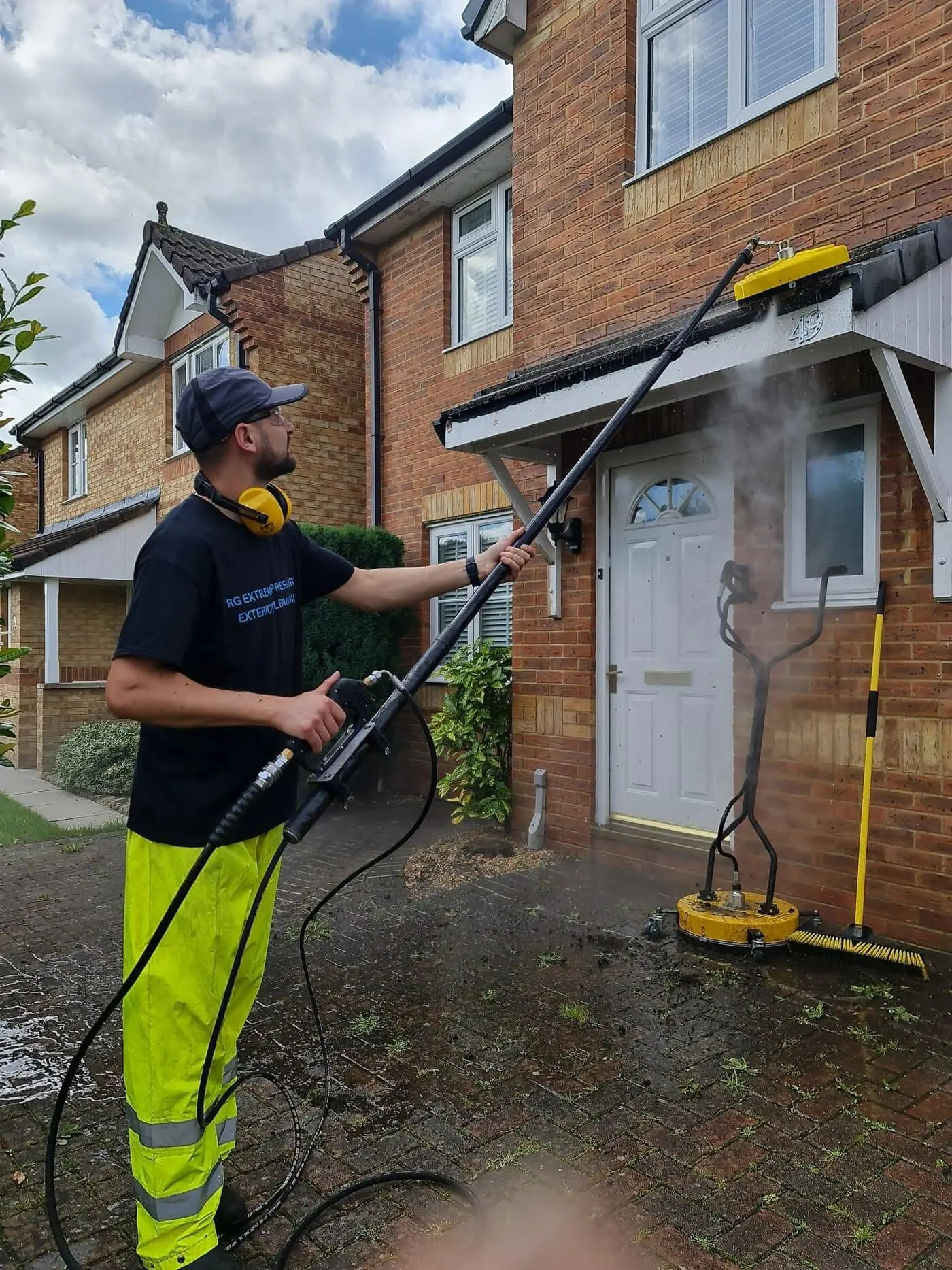
K-Rend, Parex, Weber, and other silicone or monocouche render systems have become a popular choice for external wall finishes across Bath and Bristol over the past decade. They look sharp when new — but they pick up algae, black streaking, and atmospheric pollution in ways that traditional sand-and-cement render doesn’t.
The question homeowners ask most often: can you clean modern render without damaging it?
The short answer is yes — but only with soft washing. Here’s why.
What Soft Washing Actually Means
Soft washing isn’t a brand name or a marketing term — it’s a method. Instead of using high-pressure water to blast contaminants off a surface, soft washing uses low-pressure water to apply a biocide solution that kills the organism at the root. The water pressure is comparable to a garden hose; it’s the chemistry doing the work, not the pressure.
The biocide — typically a surfactant-based algicide — penetrates the algae, lichen, or moss and breaks down the cellular structure. Once the organism is dead, it can be rinsed away gently without needing high-pressure removal.
Why High Pressure Damages Render
Modern silicone and monocouche renders have a fine aggregate surface texture that gives them their characteristic appearance. High-pressure jet washing can:
- Erode the surface texture — particularly at close range or with a lance rather than a surface cleaner
- Open up micro-cracks — render expands and contracts with temperature; any existing hairline cracks get wider under high pressure, creating entry points for moisture
- Strip integral colour — coloured renders like K-Rend have pigment mixed through the material, but surface pigment is the most concentrated layer; abrasive cleaning fades it
- Lift sealant coats — some render systems have a clear or tinted sealant over the top; high pressure strips this off, removing the render’s water-repellent properties
The damage is often invisible immediately after cleaning but shows up over the following months as accelerated algae regrowth (because the surface is now more porous), streaking, or patchy discolouration.
The K-Rend Manufacturer Position
K-Rend’s own technical guidance specifies that their products should be cleaned using low-pressure soft washing techniques. Using high-pressure equipment risks voiding any warranty claims on the render system — which matters particularly if you’re in the early years of a new build or recent renovation.
If you’re asking a render cleaning contractor whether they use soft washing, and they say they’ll use a pressure washer, walk away. Soft washing is non-negotiable for modern render systems.
What Soft Washing Can and Can’t Remove
Soft washing is highly effective at removing:
- Green algae (the most common issue — typically appears within 2–4 years on render in shaded positions)
- Black algae (slower-growing, more stubborn, but responds well to extended dwell time with biocide)
- Lichen (small grey-green crusts — requires longer treatment time)
- Atmospheric staining and general grime
Soft washing is less effective on:
- Rust staining — typically caused by iron fixings corroding behind the render; needs specialist rust treatment
- Mortar smears or construction residue — mechanical removal or acid treatment required; best addressed separately
- Paint or coating — soft washing won’t strip paint; that’s a different job entirely
How Often Does Render Need Cleaning?
In Bath and Bristol’s damp climate, silicone and monocouche renders typically develop visible algae within 3–5 years — faster on north-facing elevations or walls shaded by trees or neighbouring buildings. Once algae appears, it holds moisture against the surface, which accelerates further growth.
A biocide treatment after cleaning extends the clean period significantly. Applied to the render after soft washing, biocide inhibits regrowth and can keep the surface clean for an additional 2–3 years.
For most properties in the region, a full soft wash cycle every 4–6 years is realistic maintenance.
What a Professional Soft Wash Job Looks Like
A reputable render cleaning contractor will:
- Pre-inspect the render for existing cracks, damage, or areas of hollow render before starting
- Apply biocide at appropriate concentration for the organism being treated
- Allow sufficient dwell time (this can be anywhere from 20 minutes to several hours depending on the level of growth)
- Rinse at low pressure — never using a rotary surface cleaner or high-pressure lance directly on the render
- Apply post-wash biocide treatment if requested
Ask for evidence of public liability insurance and, ideally, a portfolio of render cleaning work. Render damage claims are expensive and your contractor’s insurance needs to be adequate.
Bath and Bristol Render Cleaning
Properties in Bath’s conservation areas and Georgian terraces often have traditional lime render rather than modern silicone systems — this needs even more care, as lime is softer and more vulnerable to mechanical damage. The soft wash principle applies here too, but the chemistry and dwell times differ.
Bristol properties, particularly modern new builds and recently-renovated houses in Clifton, Redland, and Bishopston, more commonly feature K-Rend and Weber systems.
If your render needs cleaning and you want it done correctly, get in touch for a no-obligation quote. We use soft washing exclusively on all render types across Bath, Bristol, and Somerset — no pressure washing on render, ever.