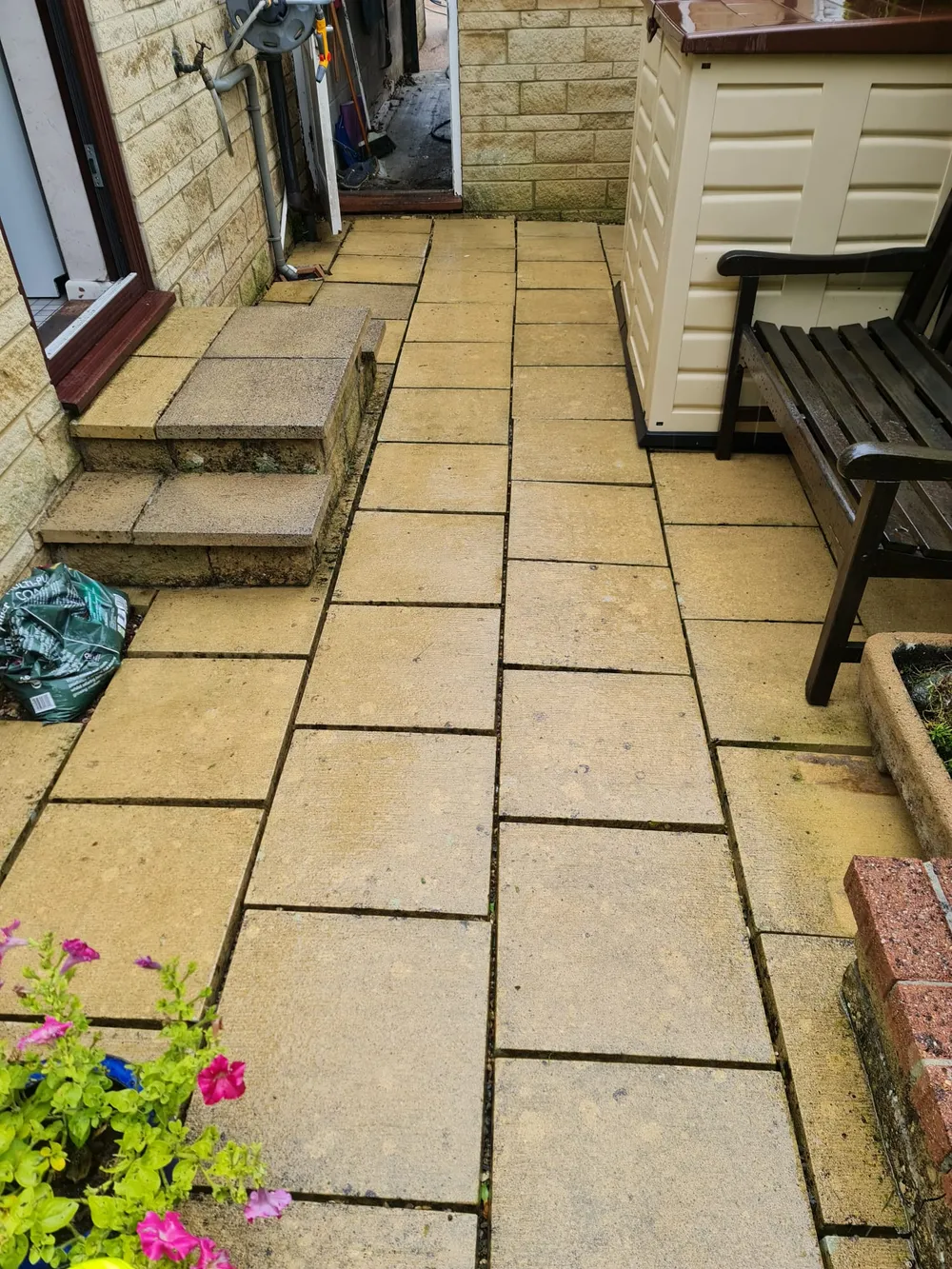
If your patio goes green every spring, you’re not imagining things. Algae is one of the most persistent problems on outdoor hard surfaces in the UK — and the usual response (grab the jet washer, blast it off, repeat next year) doesn’t solve the underlying problem.
Here’s why algae keeps coming back, and what actually works long-term.
Why Algae Grows on Patio Slabs
Algae is a simple organism that needs three things: moisture, light (or in the case of some species, shade), and something to grip onto.
Patio slabs in the UK tick all those boxes. They’re:
- Porous — concrete slabs in particular absorb moisture and take a long time to fully dry out after rain
- Horizontal — flat surfaces collect water and organic debris rather than shedding it
- Often shaded — patios next to house walls, fences or trees dry out slowly
- Textured — riven or sawn stone finishes give algae spores excellent purchase
The climate does the rest. The UK’s mild, wet winters mean algae can grow year-round in many regions. By March, a patio that was clean in October can already have a significant green film.
The Problem With Just Pressure Washing
Pressure washing removes the algae you can see. But it doesn’t remove the spores embedded in the pores of the stone, and it doesn’t change the conditions that allowed the algae to grow.
Within a few weeks of a wash — especially in spring — spores germinate and the cycle starts again. If the only tool in your maintenance routine is a jet wash, you’ll be doing it every year indefinitely.
This isn’t to say pressure washing isn’t useful. A thorough deep clean is the correct first step. But it needs to be followed by something that actually prevents regrowth.
What Actually Prevents Algae
1. Post-clean biocide treatment
A professional-grade algaecide or biocide applied after a thorough clean will remain active on the surface for one to two years, inhibiting spore germination. This is not the same as the diluted patio cleaner products sold in garden centres — professional treatments use higher concentrations of active ingredients and penetrate deeper into porous surfaces.
At RG Extreme Pressure, we apply a post-clean biocide treatment to all patio cleans as standard. It’s not an upsell — it’s the difference between results that last and results that don’t.
2. Patio sealing
Sealing patio slabs significantly reduces their porosity and makes them far more hostile to algae. Sealed slabs shed water quickly rather than absorbing it, which removes one of algae’s primary requirements.
There are two main types of sealer:
- Impregnating sealers — penetrate the surface and repel water without changing the appearance. Best for natural stone (sandstone, limestone, slate) and for homeowners who don’t want a sheen.
- Topical or surface sealers — sit on top of the surface and create a protective film. Available in matt or satin finish. Can enhance colour on natural stone. Better suited to concrete and porcelain.
The right choice depends on the paving material. We can advise on this during a quote.
Sealed patios typically need re-sealing every three to five years depending on wear and UV exposure.
3. Improving drainage
Water that sits on a patio surface rather than draining away is the primary driver of algae growth. If your patio has areas that don’t drain properly — low spots, blocked gaps between slabs, or a camber that directs water towards the house — fixing these will reduce algae growth more effectively than any chemical treatment.
Check that your patio falls away from the house (typically around 1:80 gradient) and that drainage channels are clear.
4. Reducing shade
Not always practical, but where possible, reducing shade over the patio significantly slows algae growth. Even trimming back overhanging branches to allow more afternoon sun can make a noticeable difference.
North-facing patios in permanent shade are the most challenging. On these, a biocide treatment applied annually is probably the most realistic maintenance plan.
5. Regular brushing
Between professional cleans, sweeping the patio regularly to remove organic debris — leaves, moss fragments, bird droppings — removes the nutrient source that algae and moss feed on. It doesn’t prevent regrowth entirely, but it slows it down.
Different Paving Types and Algae Resistance
Not all patio surfaces are equally vulnerable:
| Surface | Algae risk | Notes |
|---|---|---|
| Concrete slabs | High | Porous, absorbs moisture readily |
| Sandstone | High | Very porous — absorbs water and stains quickly |
| Limestone | Medium-high | Porous but harder surface |
| Porcelain | Low | Near-zero porosity — algae struggles to grip |
| Slate | Low | Dense surface, sheds water well |
| Brick | Medium | Depends on density and finish |
If you’re replacing a patio and algae has been a persistent problem, porcelain paving is worth considering. It’s significantly more expensive than concrete or sandstone but requires very little maintenance and stays cleaner for much longer.
When to Call a Professional
If your patio has significant green or black algae, black spot (a particularly stubborn lichen-like growth), or if it hasn’t been cleaned in more than two years, a professional clean with post-clean treatment is the most effective reset.
DIY jet washing can move algae around rather than removing it, and consumer-grade cleaning products rarely achieve the same result as professional treatments.
A professional deep clean, followed by sealing and an annual light maintenance clean, is the most cost-effective long-term approach for most patios.
We clean patios across Bath, Bristol and Somerset — block paving, natural stone, concrete, and porcelain. Get in touch for a free quote and we’ll give you an honest assessment of what your patio needs.