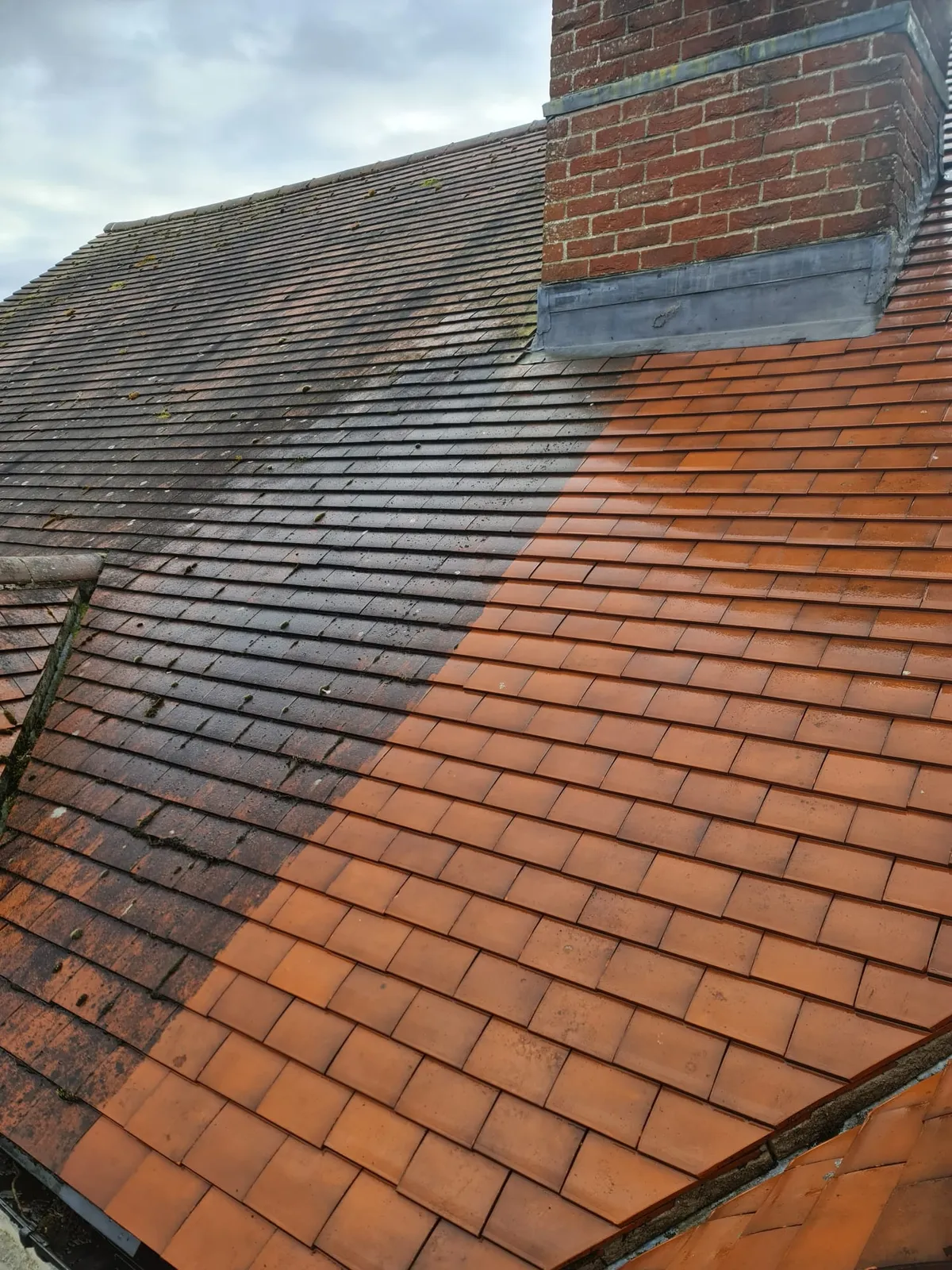
One of the first questions people ask after getting their roof cleaned is: how long before the moss comes back?
It’s a fair question. A professional roof clean is not a cheap job — scaffolding, access, labour and biocide treatment all add up. You want to know what you’re getting for your money, and for how long.
The honest answer is that it depends. But there are specific factors that determine whether a cleaned roof stays clean for two years or for eight, and understanding them helps you make a better decision about treatment and maintenance.
The Short Answer
A professionally cleaned and treated roof in the UK typically stays clean and moss-free for three to five years under normal conditions.
Without biocide treatment — if the roof is pressure washed only — moss and algae can return within 12 to 18 months, particularly in wetter, shadier conditions.
Why Moss Comes Back
Moss, lichen, and algae don’t grow on roofs because the tiles are dirty. They colonise because roofing materials provide:
- A slightly rough surface for spores to grip
- Sufficient moisture retention to germinate
- Enough nutrients from airborne particles and organic debris
Cleaning removes the growth. It doesn’t remove the conditions that allowed it to grow. Unless those underlying conditions change — or a biocide treatment is applied to inhibit regrowth — spores will recolonise the surface within months.
This is why pressure washing alone is an incomplete solution for roof moss. You’re treating the symptom, not the cause.
What Biocide Treatment Does
A post-clean biocide application (also called a moss inhibitor or algaecide) works by creating a hostile surface for biological growth. Most professional-grade treatments use an active ingredient that remains active on the tile surface for several years.
The treatment:
- Kills any residual spores left after cleaning
- Prevents new spore colonisation for an extended period
- Slows lichen regrowth (lichen is harder to kill than moss)
- Reduces the rate of organic staining from algae
At RG Extreme Pressure, we apply a professional biocide wash to every roof clean as standard. It’s included in the job — not an upsell — because the results last far longer with it than without.
Factors That Affect How Long Results Last
Aspect and shade
A north-facing roof or one heavily shaded by trees will accumulate moss significantly faster than a south-facing open aspect. Moisture evaporates slower in shade, and areas of persistent dampness are prime conditions for moss and lichen.
If your roof is north-facing or surrounded by trees, expect the lower end of the longevity range. A repeat treatment every two to three years is realistic rather than every five.
Tile type
Concrete roof tiles are more porous than clay or slate and absorb moisture more readily. They tend to grow moss faster and need more frequent maintenance. Clay and natural slate are less hospitable to biological growth and, once cleaned, typically stay cleaner for longer.
Proximity to trees
Overhanging or nearby trees deposit organic debris — seeds, bark particles, leaf tannins — onto the roof surface. This debris both blocks drainage and provides nutrients for moss and algae. Properties with significant tree cover may benefit from a gutter clear and roof inspection annually, even if a full clean isn’t needed.
Local climate
The UK’s west and south-west tend to be wetter and milder, which accelerates biological growth. Properties in Bath and Bristol are in a relatively high-rainfall zone compared to, say, East Anglia. In this region, the average interval between professional roof cleans is three to four years with biocide, versus annually without.
Previous maintenance history
A roof that has been allowed to develop thick moss growth takes longer to treat fully and may need a follow-up biocide application six months after cleaning. A roof that’s been maintained regularly stays cleaner between treatments.
What to Expect in the Year After Cleaning
A freshly cleaned roof will look dramatically different immediately after treatment. Moss, algae and lichen staining are removed. However, some things to be aware of:
- Lichen staining — lichen bonds strongly to tile surfaces and may leave ghost marks even after the organism is killed. These fade over subsequent months of weathering.
- Continued die-off — if biocide was applied, you may see brown or black biological matter washing off the roof for several weeks after treatment. This is normal and means the treatment is working.
- Recolonisation starting — small amounts of algae regrowth can appear within 12 months, particularly on north-facing sections. This is normal and does not mean the clean has failed. Full biocide coverage slows this significantly.
Is Roof Cleaning Worth It?
For most properties in the South West, yes. Moss growth:
- Retains moisture against the tile, accelerating freeze-thaw damage
- Lifts tiles at the edges as root systems expand
- Blocks valleys and gutters, causing water to back up under the roofline
- Reduces the life expectancy of the roof covering
The cost of a roof clean and biocide treatment is a small fraction of a roof re-cover or repair. Maintaining a clean roof extends the life of the covering and protects the structure beneath.
We’ve cleaned and treated roofs across Bath, Bristol and Somerset. If you’re seeing significant moss growth or haven’t had the roof treated in the last four years, get in touch for a free assessment. We’ll give you a straight opinion on whether the roof needs a full clean or just a biocide top-up.